The Flood
My high school art teacher, let’s call her “Patsy,” was…artsy. She wore shoulder-length white hair that matched the flow of her long skirts, especially on windy days. Her skin was red, or so I remember. It wasn’t the red of too much sun over her years or the red of some medical something; it was the red of imagination. And she was…imaginative.
During my freshwoman year, which was enough of a departure from the safety and security of my rural community elementary school where everybody knew everybody and everybody was poor, high school brought popularity contests and different buildings for different subjects. Home Economics and Keyboarding were taught in the round building. The G.O.B. (Good Ol’ Boys) spent much of their time in the Agriculture Building where they learned to dip Skoal, skip class, and fix everything. General Education classes were taught in the main building and Patsy and her art were housed, along with the band’s classroom, across the parking lot in a small building somewhat removed from the rest of the school. I suppose the band needed the distance for practice. I suppose Patsy needed it for her imagination.
Taking Patsy’s introductory art class as a scared 9th grader was originally promising. One-fourth of my daily class time would be spent in creation. I would learn to draw, to use colors and brush strokes and most importantly, I would be in class with two of my friends from elementary school. Sweet relief.
Patsy made class…artsy. She was always flustered and looking for something that she had just placed… Where was it?… She just used it and… Oh, let’s just do something else. She was lenient with the day’s instruction, not-so-lenient with two young women who seemed to struggle with making it to class by 2:00p.m. They were late most every day and one of those every days, Patsy had enough. It was raining that afternoon, common in the North Carolina Mountains, and seeing that the two young women were once again absent as class began, Patsy made her way to the classroom door, locked it, turned around to face us with her pleased red skin, and continued instruction. When the knocks came, once, twice, three times, Patsy laughed.
“This must be what Noah felt like on the ark,” she said. “Ha! Ha!”
But was it?
Did Noah hear the pleas of friends and laugh at their destruction? Or did he know how hard it was to believe something that had never been seen? Did he build the ark out of acceptance of the unknown or fear? Was there any difference? Did he really know what to expect? How it would feel to close the door? How it would feel to open it back up, 40 days later, and see a different world?
Did he blame those who suffered the way we do?
“They should have known,” we say.
When the rains came to New Orleans in 2005, they stayed longer than anyone expected. The Big Easy had seen its share of hurricanes and destruction in its history and orders for evacuations had been issued as Katrina approached the Gulf Coast. Many people left, unsure of what they would come home to, if anything at all. Many people stayed, maybe hopeful that what they had seen and survived before they would see and survive again, or maybe because they had no place else to go and even if they did, there was no car to get there and no money for a one-way ticket. Natural disasters tend to prevent the need for round-trip fare. Then the levees broke and the freshwomen knocking on the door to the art room became the families stranded on roofs. The home of the Saints became a bed for thousands of sweaty, dirty, tired, terrified bodies under the watch of the National Guard, as though they were criminals. On the roof and the 50-yard-line, clean drinks were scarce. The city was surrounded by water and people were thirsty.
We said they should have known. Known what? That they would be stranded on top of their homes? That they would be filmed begging for help? That they would be ridiculed for clinging to hope? That the levees would give? That they would sweat out August days without showers, clean clothes, safe roads, pets, information, and dignity? That they would suffer at our hands and we would put it in theirs?
They should have known what?
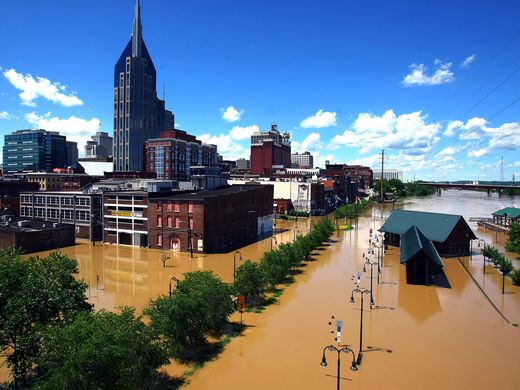
And when the rains came to Nashville in May 2010, were we, too, supposed to know that we would lose hot water? That what was a front porch would turn into a treehouse when it ripped from its foundation and got stuck in the neighbor’s yard at the end of the street? That flooded walls would crumble with the tap of a hammer? That face masks would become the norm of recovery? That Broadway would turn into a swimming hole? That just like in New Orleans, there would be water everywhere and water nowhere?
We should have known what?
And when the rains fell inside a Honda Accord parked on Clifton Lane in November 2011, what should I have known? That the drops would turn to hail with every word? That the laughter of a drunk and angry man would sing backup to phone messages from a woman crying over losing his child? That as he saw it, I had “Abuse me” tattooed on my forehead? That I had no reason to believe myself anything other than a psychotic, manipulative bitch that deserved what I had coming to me? That without realizing it, I would lose my ability to move and gain my ability to scream…
“WHAT HAPPENED TO YOU?!”
“WHY ARE YOU DOING THIS?!”
“PLEASE STOP!”
“PLEASE!”
“STOP!”
That if he had stayed one more day, one more hour, one more beer, his hand would have left a mark to match my forehead? That without that mark, I didn’t know if people would believe me?
I should have known what?
As a freshwoman, I understood Patsy’s frustration. I’m a bit of a prude with time, too. As someone who had never experienced complete devastation through natural disasters, I shared the voice of many Americans who questioned, “Why didn’t they leave?” when Katrina made landfall on the Gulf Coast. As an observer, I even questioned an old friend whose marriage was controlled by her husband. Why did she stay?
Those aren’t the questions of healing; they are the questions of blame. They are the questions of unworthiness, the questions of doubt. They don’t offer compassion, understanding, or presence; they leave the already damaged believing that the loss of place and safety is their fault. They shame.
Why didn’t Noah’s friends get on the ark? Why was he wearing a hoodie? Why didn’t all the people in New Orleans listen? Why was he selling cigarettes? Why did she put on that skirt if she didn’t want the attention? Why was he playing with a toy gun? Why don’t they just go back to their country?
Because they should have known they would drown, or be murdered, or stranded, or choked, or raped, or shot, or targeted in a hate crime, or locked inside a cage?
They, we, you, I should have known what?

